How to Pay Offshore Employees


Hiring offshore employees can help your business access global talent, reduce costs, and scale faster. But once you start paying employees in another country, the process becomes more complicated than simply sending a bank transfer.
You need to think about worker classification, local labor laws, payroll taxes, exchange rates, payment methods, and compliance in both the United States and the employee’s home country.
If you are wondering how to pay offshore employees legally and efficiently, the short answer is this: you need the right payment structure, the right documentation, and a compliant payroll process. In many cases, businesses use an employer of record, international payroll provider, or contractor payment platform to simplify the process.
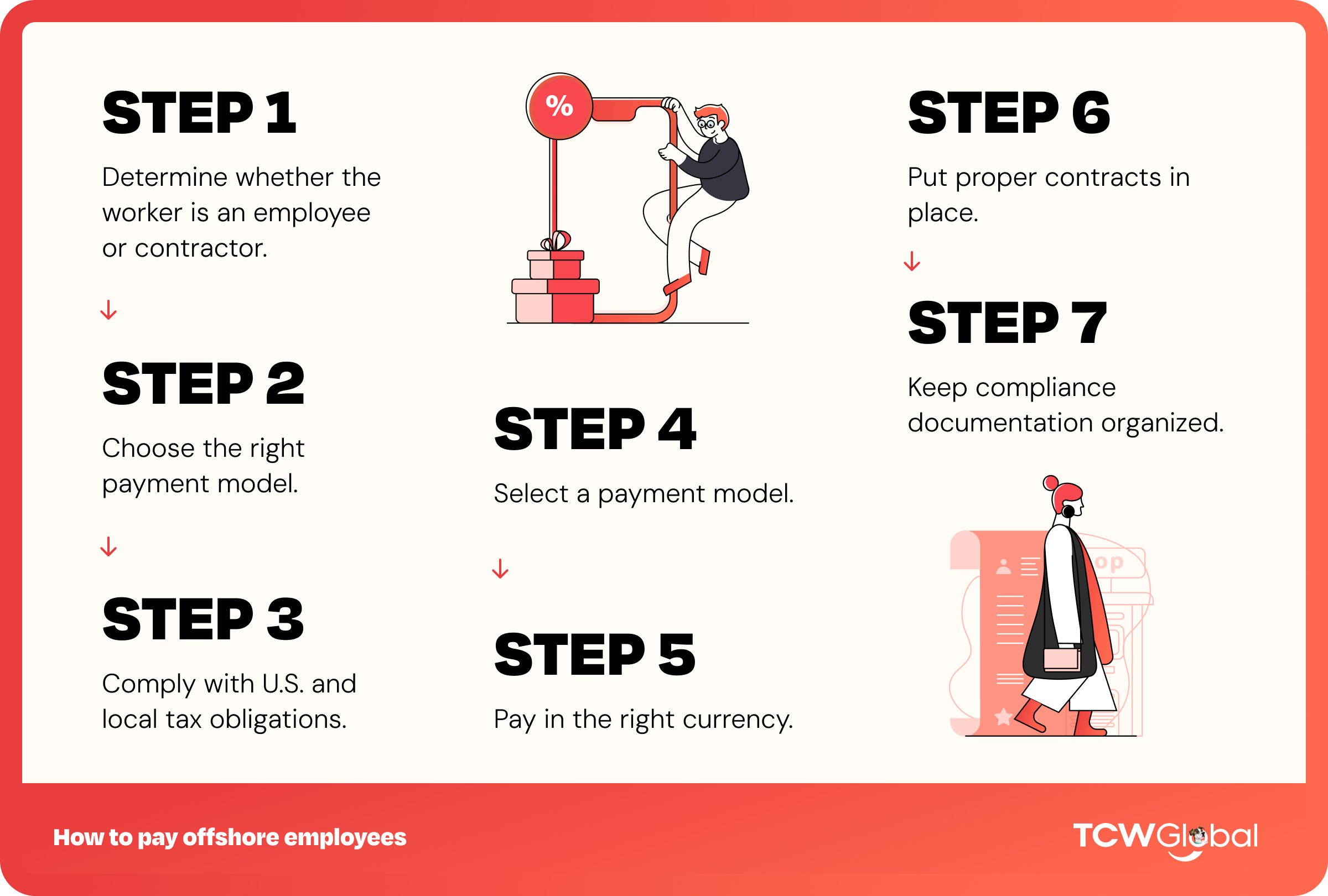
Table of Contents
What does “offshore employee” mean?
Why paying offshore employees is more complex than domestic payroll?Step 1: Determine whether the worker is an employee or contractor
Step 2: Choose the right payment model
Step 3: Comply with U.S. and local tax obligations
Step 4: Select a payment method
Step 5: Pay in the right currency
Step 6: Put proper contracts in place
Step 7: Keep compliance documentation organized
When to use an Employer of Record
What does “offshore employee” mean?
An offshore employee is a worker who performs services for your company from another country. In some cases, they may be a direct employee of your company. In others, they may technically be employed through a local entity, an employer of record, or a staffing partner.
This distinction matters because the way you pay someone depends on how they are classified. A true employee usually requires payroll registration, tax withholding, benefits administration, and compliance with local labor laws. A contractor is paid differently and generally handles their own taxes, though misclassification can create serious legal risk.
Why paying offshore employees is more complex than domestic payroll?
Paying employees in another country is not just about transferring money across borders. Every country has its own rules for wages, overtime, benefits, statutory deductions, and employment protections. A payment method that works in the U.S. may not be efficient or legal elsewhere.
Common challenges include:
-
Determining whether the worker is an employee or contractor
-
Complying with local tax and labor laws
-
Paying in the correct currency
-
Managing foreign exchange fees
-
Handling banking restrictions or transfer delays
-
Making sure contracts and payroll records are audit-ready
If you get any of these wrong, you may face penalties, back pay obligations, tax issues, or worker disputes.
Step 1: Determine whether the worker is an employee or contractor
It is important to distinguish between independent contractors and employees to avoid misclassification penalties.
Offshore employee
An offshore employee is usually part of your workforce and may be treated similarly to a domestic employee. You may be responsible for:
-
Employment contracts
-
Local payroll registration
-
Tax withholding
-
Social contributions
-
Mandatory benefits
-
Leave and termination rules
Offshore contractor
An offshore contractor is typically an independent business or self-employed individual. In this case, you usually pay invoices rather than running them through payroll. Contractors often manage their own taxes and benefits.
Why classification matters
An offshore employee is usually part of your workforce and may be treated similarly to a domestic employee. You may be responsible for:
-
Tax penalties
-
Fines
-
Liability for unpaid benefits
-
Retroactive employment obligations
A good rule of thumb is that if the company controls how, when, and where the person works, they may be more likely to be considered an employee under local law.
Step 2: Choose the right payment model
There are several ways to pay offshore employees, and the best option depends on your company size, risk tolerance, and global hiring strategy.
Establish a local entity
If your company has a legal entity in the employee’s country, you may be able to hire them directly and run local payroll yourself.
This requires:
-
Entity setup
-
Local payroll expertise
-
Knowledge of local employment law
-
Country-specific tax compliance
Employer of record: If the person is a true contractor, you can use a global payment platform to send funds across borders and keep documentation organized. These platforms often support multiple currencies, recurring payments, invoices, and compliance records.
Wire transfer or bank transfer: You can also pay offshore workers directly through international bank transfers. This works, but it can be slower and more expensive due to intermediary bank fees and exchange rate markups.
Step 3: Comply with U.S. and local tax obligations
Tax compliance is one of the biggest differences between domestic and offshore payroll.
For offshore workers
You may need to account for the following:
-
Local income tax withholding
-
Social security or similar contributions
-
Employer payroll taxes
-
Mandatory pension or insurance programs
-
Annual reporting requirements
-
Making sure contracts and payroll records are audit-ready
Depending on the country, the employer may need to register with local tax authorities before making payments.
For offshore contractors
If the worker is truly a contractor, your obligations are usually lighter, but documentation still matters. You typically want:
-
A signed contractor agreement
-
Invoices for services rendered
-
Proof of foreign status where applicable
-
Records showing the contractor operates independently
For U.S. businesses, payment reporting obligations can still apply depending on the structure and the country involved, so you should not assume that “foreign” automatically means “no paperwork.”
Step 4: Select a payment method
Once compliance is sorted, you need a reliable payment method.
International bank transfer
This is one of the most common methods for paying offshore workers. It is familiar and widely accepted, but it can be slower and more expensive than newer fintech options.
Pros:
-
Widely available
-
Trusted by most workers
-
Good for larger payments
Cons:
-
Foreign exchange fees
-
Intermediary bank charges
-
Slower settlement times
Global payroll platform
Platforms designed for international payroll can automate recurring payments, currency conversion, compliance documentation, and approvals.
Pros:
-
Streamlined payroll workflow
-
Better compliance tracking
-
Multi-currency support
- Easier scaling
Cons:
-
Monthly platform fees
-
Setup time
-
Not always ideal for very small teams
Contractor payment platform
Platforms designed for international payroll can automate recurring payments, currency conversion, compliance documentation, and approvals.
Pros:
-
Simplified administration
-
Better recordkeeping
-
Multiple payment methods
Cons:
-
Better for contractors than employees
-
May still require legal review for classification
Step 5: Pay in the right currency
One of the biggest mistakes companies make is assuming that offshore worker want to be paid in US dollars. In many cases, the worker may prefer local currency because it reduces uncertainty and avoids conversion losses.
Paying in local currency can:
-
Improve worker satisfaction
-
Reduce exchange-rate complaints
-
Make budgeting easier for the worker
However, local currency payments can also introduce FX volatility on your side. Some companies choose to set salaries in USD-equivalent terms while paying in local currency based on the exchange rate at the time of payroll.
Step 6: Put proper contracts in place
Contracts are essential when paying offshore workers. They protect both parties and clarify expectations.
A strong offshore employment or contractor agreement should include:
-
Job title and responsibilities
-
Payment amount and currency
-
Pay schedule
- Benefits or allowances, if applicable
- Termination terms
- Confidentiality obligations
- IP ownership
- Local law governing the arrangement
For contractors, the contract should clearly state that the person is an independent service provider, not a worker, if that is the intended legal relationship.
Step 7: Keep compliance documentation organized
When you pay offshore workers, documentation is just as important as the payment itself. You should keep records of:
-
Signed agreements
-
Invoices
-
Timesheets, if applicable
- Tax forms
- Proof of payment
- Payroll reports
-
Communications about pay changes or approvals
Good documentation helps if you ever face an audit, a tax question, or a worker dispute.
When to use an Employer of Record
An employer of record is often the easiest solution if you want to hire offshore employees quickly without setting up a foreign entity. This is especially useful if your company:
-
Has 1 or a few workers in that country
-
Does not want to manage local payroll and legal compliance yourself
-
Is hiring in a new country for the first time
- Wants to reduce employment risk
For many growing businesses, an EOR is the most efficient way to pay offshore employees while staying compliant.