W-2 vs. W-9: What’s the Difference and When to Use Each


W-2 vs. W-9 forms help businesses classify workers correctly and meet IRS tax rules. Employers use W-2 for employees with withholdings, while W-9 gathers info from contractors for potential 1099 filings.
Avoid misclassification penalties with this guide.
Table of Contents
What is the difference between W-2 vs. W-9?
What is Form W-2?
What is Form W-9?
Misclassification Risk: Why This Is a CFO-Level Issue
How Worker Classification Impacts HR & People Strategy
Legal & Compliance Considerations (U.S. and Global)
W-2 vs. Contractor: Which Roles Should Be Which?
Global Expansion: Why W-9 Contractors Can Trigger Risk Abroad
How Worker Classification Impacts HR & People Strategy
W-2 vs. 1099 Worker: Which Roles Should be Which?
What is the difference between W-2 vs. W-9?
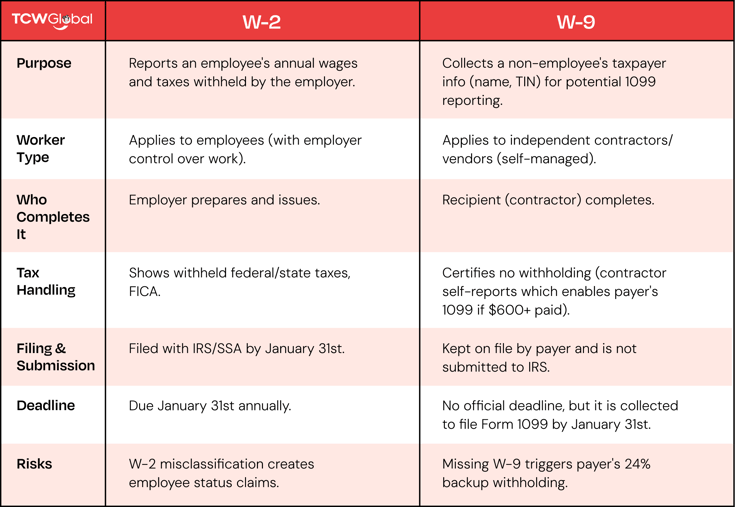
The difference between Form W-2 and W-9 is the W-2 reports an employee's wages and taxes withheld whereas W-9s collect taxpayer identification information to file Form 1099. A W-2 is for employees and a W-9 is for independent contractors so the business can issue a 1099 if needed.
1. Purpose
W-2 reports an employee's annual wages and taxes withheld by the employer. W-9 collects a non-employee's taxpayer info (name, TIN) for potential 1099 reporting.
2. Worker Type
W-2 applies to employees (with employer control over work). W-9 applies to independent contractors/vendors (self-managed).
3. Who Completes It
Employer prepares and issues W-2. Recipient (contractor) completes W-9.
4. Tax Handling
W-2 shows withheld federal/state taxes, FICA. W-9 certifies no withholding (contractor self-reports which enables payer's 1099 if $600+ paid).
5. Filing/Submission
W-2 filed with IRS/SSA by January 31st. W-9 kept on file by payer and is not submitted to IRS.
6. Deadline
W-2 is due January 31st annually. No official deadline for W-9, but it is collected to file Form 1099 by January 31st.
7. Risks
W-2 misclassification creates employee status claims. Missing W-9 triggers payer's 24% backup withholding.
What is Form W-2?
Form W-2 is the IRS-mandated annual summary employers provide to employees and file with the Social Security Administration (SSA). It details total wages, tips, and other compensation paid during the tax year, alongside federal, state, and local taxes withheld, as well as Social Security, Medicare (FICA), and sometimes additional Medicare tax.
Key components include:
-
Boxes 1-6 (Wages/Taxes): Box 1 shows taxable wages (up to limits); Box 2 federal income tax withheld; Boxes 3-6 FICA elements.
- Boxes 12-14: Deferred compensation (401(k)), benefits, retirement plan codes.
-
State/Local Sections: Withholdings specific to jurisdictions.
What is Form W-9?
Form W-9 is a one-page info-gathering tool payers use for non-employees (contractors, vendors, freelancers). Recipients self-certify their name, business name, address, TIN (SSN, EIN, or ITIN), entity type, and exemption from FATCA/backup withholding.
Key components include:
-
Part I: Name and TIN must match IRS records to avoid mismatches on future 1099s
-
Part II: Address and certification signature (under penalty of perjury)
-
No Filing: Payers retain indefinitely; not submitted to IRS
Worker Misclassification Risk: Why This is a CFO-Level Issue
While the structural differences between W-2 employees and 1099 contractors are straightforward, the implications are not. For finance, HR, and legal leaders, this classification decision directly impacts cost, compliance, and workforce strategy.
Worker misclassification has become one of the most expensive workforce risks. Potential consequences include
-
Back taxes (employer + employee portions)
-
Penalties and interest (25%-40% of unpaid taxes)
-
Wage and hour claims (ranges $5K - $50K per worker)
-
Class-action lawsuits
How Worker Classification Impacts HR & People Strategy
Worker classification shapes HR and people strategy by influencing talent acquisition, retention, costs, culture, and agility. Classifying workers as W-2 employees commits HR to full lifecycle management including recruiting, onboarding, benefits administration, performance reviews, and career development.
W-9 independent contractors shift focus to vendor sourcing, contract negotiation, and project-based oversight, freeing resources for core employee engagement. Over-reliance on W-9 contractors risks talent gaps since they lack loyalty or institutional knowledge gained through W-2 tenure. On the other hand, W-2 investment creates fixed costs and slower pivots during market shifts.
W-2 vs. 1099 Workers: Which Roles Should be Which?
In summary, W-2 workers have core business functions, their roles require direct supervision, and they have long-term, ongoing work. 1099 workers perform project-based work, have specialized expertise, and are given clearly defined deliverables.
Learn more about the differences between W-2 and 1099 workers.